Skip to content

Many families need to carry a loved one's ashes on a plane, whether to bring them home, to share them with relatives interstate, or to scatter them somewhere that mattered. The good news is that it is allowed, and with a little preparation it is usually straightforward.
The short answer
Cremated remains are not dangerous goods. Australia's Civil Aviation Safety Authority (CASA) lists ashes as generally allowed in both carry-on and checked baggage, but notes that airline approval is required and each airline's conditions can differ. So the rules that matter are your airline's.
What every airline will want
- A sealed container that cannot spill or leak.
- Paperwork from the funeral director or crematorium confirming what the container holds. Keep it with you, not in your checked bag.
- The container stays closed for the whole journey. Security staff will not open it.
- Normal baggage limits apply, so the container and its bag must fit your carry-on size and weight allowance.
- Screening: if you carry the ashes on board, the container will go through the X-ray machine.
Airline by airline
Qantas
Qantas accepts ashes in the cabin or as checked baggage. Bring a certificate from the crematorium that confirms the contents, and check the current conditions on qantas.com or with the airline before you fly.
Virgin Australia
Virgin Australia accepts human and animal ashes in carry-on or checked baggage. The ashes must be in a sealed urn that cannot spill, cushioned against breakage with suitable packaging. In the cabin, the urn must sit wholly inside a bag that meets carry-on size and weight limits, and the bag and urn stay closed during the flight.
Jetstar
Jetstar accepts human and animal ashes in carry-on or checked baggage. You need an official document (or certified copy) from a funeral director or crematorium confirming the contents. The container must be clean of soil, sealed so it cannot leak, and stay closed throughout the journey. Jetstar also asks travellers to check whether the departure or arrival airport has any extra declaration requirements.
Choosing the right container to travel with
The biggest practical issue is screening. Dense metal or stone can stop the X-ray from showing what is inside, and staff will not open the container to check. Many families avoid any problem this way:
- Fly with the ashes in the crematorium's container. It is usually sturdy, well sealed and labelled, and it screens easily.
- Send or pack the urn separately. Pack an empty urn well cushioned in checked luggage, or have it delivered to where you are going.
- Transfer the ashes when you arrive. Our guide to filling a cremation urn with ashes walks you through it.
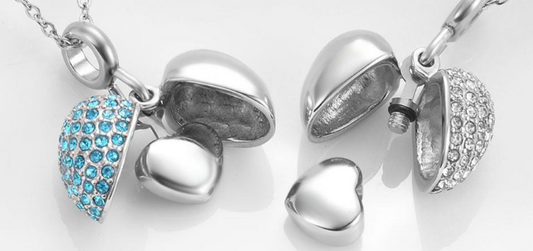
If only part of the ashes is travelling, for a scattering or for a relative to keep, a small keepsake urn is easier to carry and pack. If the ashes are going to be scattered, a scattering tube is light, simple to carry and designed for the ceremony itself.
Flying overseas
For international travel, check both the airline's rules and the destination country's. Some countries ask for a death certificate and cremation certificate on arrival, and rules for pet ashes can differ from rules for human ashes. The destination country's embassy or government website is the place to confirm.
A simple checklist
- Check your airline's current rules a few days before you fly.
- Get the crematorium certificate or funeral director's letter, and a copy.
- Use a sealed, X-ray-friendly container in the cabin.
- Pack it in a bag within your carry-on limits.
- Allow a little extra time at security.
- If you plan to scatter when you arrive, read the scattering rules for each Australian state.
Airline rules change. This guide summarises published airline and CASA information at the date it was last reviewed (shown under the title), so always confirm with your airline before travelling.
Read next: Biodegradable Urns in Australia: A Gentle Guide to Eco-Friendly Farewells