Skip to content

The moment you bring your pet's ashes home, you may find yourself holding a small box or bag and having absolutely no idea what to do next. Nobody really prepares you for that part.
Pet loss is real, significant grief, and the good news is that the UK is finally catching up with that truth. From professional pet bereavement counselling to a growing range of pet urns for ashes, there is more support and more choice available to you than ever before. The tricky part is knowing where to start.
This guide is designed to walk you through the entire journey, from the day your pet's ashes arrive at your door right through to marking anniversaries years down the line. You will learn how to receive the ashes with care, how to choose a memorial space that feels right, which keepsake formats suit different personalities, and how to build rituals that are genuinely meaningful rather than just going through the motions.
Whether you lost your companion last week or last year, consider this your practical, gentle roadmap through one of life's most underestimated losses.
Your Grief Is Real: Understanding Pet Loss in the UK Today
If you are reading this, you are probably navigating one of the harder experiences pet ownership brings. That grief is real, and it deserves to be taken seriously.
Across the UK, millions of households own at least one pet, with companion animals living alongside families in homes nationwide. When a companion dies, that loss touches an enormous number of people, yet it remains one of the least socially acknowledged forms of bereavement. There is rarely a card through the letterbox. Workplaces seldom offer formal time to grieve. The world tends to carry on.
That is beginning to change. Research shows that 43% of UK respondents now support statutory paid leave for pet bereavement, a figure that reflects a genuine cultural shift in how this country thinks about the human-animal bond. Dedicated pet bereavement support is now available through trained volunteers and support lines in the UK, a sign that the mental health community recognises what so many owners already know: losing a companion can be as painful as any significant loss.
Part of what makes pet loss feel particularly isolating is the absence of ready-made rituals. Human bereavement has funerals, wakes, and widely shared customs to lean on. Pet loss, in most Western cultures, does not. Many owners are left wondering what to do, and in what order, with no clear script to follow.
This piece is here to offer one. The sections ahead map a gentle, sequenced path from the day ashes arrive home through to how anniversaries can be marked in ways that feel genuinely meaningful. There is no single correct approach, only what feels true to the relationship you had.
How Most UK Pet Owners Receive Ashes: What to Expect
Once you know that grief is real and valid, the next practical question arrives: what actually happens when a pet is cremated in the UK, and will you receive ashes at all?
The answer depends entirely on which type of cremation was arranged, and many owners are surprised to discover this distinction exists.
Most veterinary cremations are communal. This means several animals are cremated together, and individual ashes are not separated or returned. It is the most common arrangement made through vet practices, and it is worth knowing that if receiving your companion's ashes matters to you, you will need to request a private or individual cremation explicitly. This is not something that happens automatically.
If you are still in the planning stage, it helps to ask your vet or chosen crematorium directly: "Will I receive my companion's ashes back?" A clear answer before the day avoids a painful misunderstanding afterwards.
For those looking beyond the vet practice, over 130 dedicated pet crematoriums and cemeteries now operate across England. Many offer farewell rooms, gardens of remembrance, and more personalised services than a standard veterinary referral provides. The UK pet funeral services market reached £110 million in 2024 and is projected to reach £195 million by 2030, reflecting how rapidly these services are expanding.
Knowing what you have arranged, before the day, means you can prepare yourself emotionally for what arrives home. If you are hoping to choose an urn or keepsake, exploring cremation urns for ashes across different styles and sizes can be a gentle first step while you wait.
Receiving the Ashes: How to Bring Them Home Thoughtfully
Once you know what type of cremation has been arranged, the next step is simply bringing your companion home.
Ashes are typically returned in a basic plastic container, a scatter tube, or a simple temporary box. This is a functional vessel, not a final one. There is no expectation that you will transfer the ashes immediately, and no deadline for deciding what comes next.
Many owners find real comfort in simply having the ashes home. Taking a few days, or even several weeks, before choosing a permanent resting place is completely normal. The APPCC Code of Conduct confirms that returning ashes to owners is standard practice for accredited crematoriums, so you can feel assured the process has been handled with care before the ashes reach you.
Before you collect, a small act of preparation can help. Even clearing a quiet shelf, placing a favourite photograph nearby, or choosing a calm corner of a room gives the ashes somewhere to land when they arrive. It does not need to be elaborate. A windowsill with a little light is enough.
If the ashes are handed to you at a veterinary clinic, or arrive by post, a wave of unexpected emotion is very common. You might feel it the moment you hold the container. Allow yourself that moment. There is no need to compose yourself quickly or move on to the next task. Sitting with that feeling, however briefly, is an act of care toward yourself.
Some owners mark the homecoming with a quiet private ritual: lighting a candle, putting on a piece of music their companion always heard, or simply sitting still for a few minutes. Nothing formal is required. When you feel ready to think about transferring the ashes, this guide on how to prepare to transfer the ashes offers gentle, practical steps.
Choosing and Using a Pet Urn: Making the Transfer with Dignity
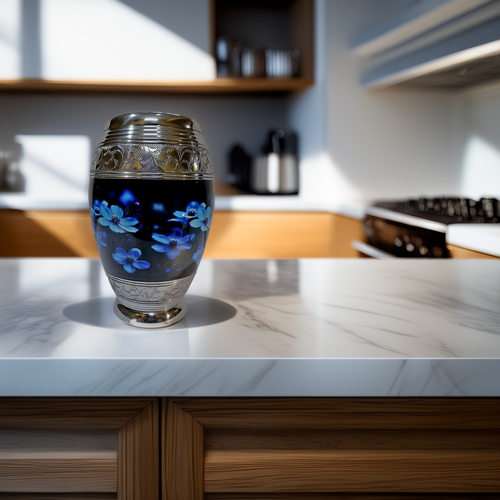
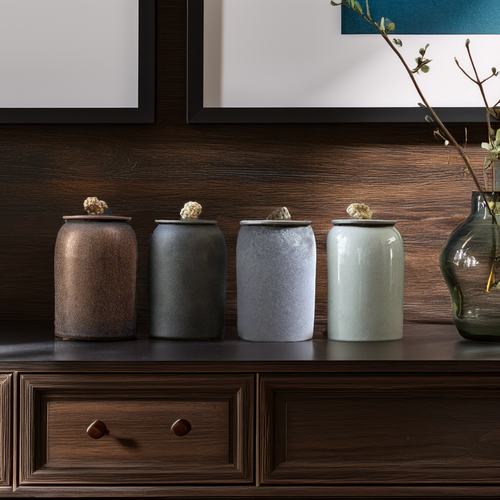
When you feel ready to choose a permanent home for your companion's ashes, pet urns for ashes are available in a wide range of materials: ceramic, wood, metal, and biodegradable options. The right choice depends on two things, where you intend to keep or eventually scatter the ashes, and what feels emotionally right for the animal you are remembering.
Sizing Your Urn
For urns for dogs ashes, check the urn's stated cubic-inch capacity against the specification sheet provided by your crematorium, which will give the actual ash volume for your companion's size. Always go slightly larger if you are between sizes.
For urns for cat ashes, your crematorium will be able to confirm the ash volume for your cat so you can match it to a urn's stated capacity. A pet or keepsake ashes cremation urn with clear capacity specifications takes the guesswork out of this step.
Transferring the Ashes
When you are ready to move the ashes from their temporary container, consider treating it as a quiet, intentional moment rather than a practical task. Work slowly, stay present, and say whatever feels natural, even if that is simply your companion's name. There is no formal script required.
Before purchasing, check the closure mechanism carefully. A well-fitted, secure seal provides lasting peace of mind, particularly if the urn will be displayed somewhere busy or moved between locations.
If You Would Rather Not Do It Alone
There is no obligation to carry out the transfer yourself. Many crematoriums and memorial providers, including those affiliated with the Association of Private Pet Cemeteries and Crematoria, can handle this on your behalf, with the same care and dignity applied throughout the process. Asking for that support is a perfectly reasonable choice.
Creating a Dedicated Memorial Space at Home
Modern pet memorial options now include everything from handcrafted ceramic urns to living plant memorials, and the range of choice can feel both helpful and overwhelming. It does not need to be elaborate. Once your companion's ashes have a home in a chosen urn, a corner of a mantelpiece, a small shelf in a quiet room, or a spot by a window can hold just as much meaning as a purpose-built memorial garden. What matters is that the space feels intentional.
Gathering a few significant objects alongside the urn helps create that sense of intention. A favourite toy, a worn collar, a paw print, a photograph taken in a happy moment, or a plant they used to curl up beside can all bring the space to life in a way that feels personal rather than staged. There is no formula here; trust what feels right.
For those with outdoor space, a garden memorial is a deeply rooted choice in the UK. A planted shrub, a simple memorial stone, or a quiet scatter area can serve this purpose without requiring significant cost or effort.
If you rent, or live without a garden, an indoor arrangement works just as well. A small urn, a framed photograph, and a single potted plant create a contained tribute that can move with you if needed. A thoughtfully chosen keepsake urn can sit comfortably even in a modest space without feeling out of place.
The space is allowed to change. What feels right in the first raw weeks may feel different after a few months. Simplifying it, adding to it, or moving it to a different room as your grief settles is not disloyalty; it is the memorial space doing its job.
Lighting a candle there, particularly in the early days or on significant dates, is one of the simplest grounding rituals available. It needs no religious framing and no ceremony; just a quiet moment of acknowledgement.

Matching a Pets Ashes Keepsake Format to Your Personality and Grief Style
Once you have your memorial space arranged, the next question many people find themselves sitting with is: what form should your companion's ashes actually take going forward?
There is no single answer, and there is no convention you need to follow. A pets ashes keepsake can be a full urn at home, a small shared keepsake urn, a piece of jewellery, or something that returns gently to nature. The format that serves your grief is the right one.
If you find comfort in a visible, permanent focal point
A beautifully crafted full-sized urn, displayed somewhere meaningful at home, gives you a stable place to direct your love. Many people find it quietly reassuring to have their companion present in a physical, daily way. The urn becomes both a resting place and a focal point for memory.
If you need to carry your companion close
Cremation jewellery, such as a pendant, ring, or bracelet holding a small portion of ashes, allows the relationship to continue in a portable, private way. It requires no explanation to anyone, and can simply be a source of quiet comfort throughout the day.
If more than one person in your household is grieving
Keepsake urns make it possible to divide ashes respectfully, so that each person holds a portion in a form that suits them. One family member might keep a small pet or keepsake ashes cremation urn on a shelf, while another chooses jewellery. Both are equally valid.
If you feel drawn to nature and the idea of return
Biodegradable urns designed for water or earth allow ashes to be scattered or planted as a living memorial, such as a tree or wildflower patch. Many people find this form of return deeply meaningful.
If you are simply not ready yet
That is entirely normal. Keeping ashes in a temporary container while you take your time is not avoidance; it is patience. There is no deadline, and many people take months before choosing something permanent.
When More Than One Person Grieves: Sharing Ashes with Care
When a pet is loved by a whole household, the grief belongs to more than one person. Dividing ashes is one way to honour that.
In the UK, there are no legal restrictions on dividing a pet's ashes between family members, partners, or separate households. This is different from the rules that apply to human cremation remains, where regulations are more complex. Once ashes are returned to you, what happens next is entirely your decision.
How to divide ashes with care
Treat the process as a shared ritual rather than a household task. Use a clean, dry spoon and transfer each person's portion into an individual sealed container or small keepsake urn. Work slowly, stay present, and if it feels right, say a few words together. The care you bring to the moment matters.
Once divided, each person is free to choose their own form. One may want a keepsake urn on a windowsill; another may prefer a piece of cremation jewellery to carry their companion close, such as a pendant holding a small portion of ashes; a third may wish to scatter their portion somewhere meaningful. There is no requirement for everyone to do the same thing.
Talk before you divide
A gentle conversation beforehand, about who would like to hold ashes and in what form, prevents misunderstanding and ensures no one's grief is overlooked. These conversations can feel tender, but they often bring families closer.
Including children
Children grieve too, and they benefit from having something tangible to hold. A paw print cast, a framed photograph, or a small personalised keepsake can give a child a meaningful connection to their pet, whether or not they hold ashes directly. Let their age and temperament guide what feels right.
Scattering Ashes in the UK: Meaningful Places and Practical Guidance
Once you have decided how the ashes will be shared, or if scattering is the right path for you alone, it helps to know that the practicalities in the UK are relatively straightforward.
There are no specific laws prohibiting the scattering of pet ashes on private land or in most public outdoor spaces. If you are on private land that is not your own, it is courteous to ask the landowner's permission first. On beaches, open countryside, or public parks, scattering is generally accepted, though a quiet word with a local authority can offer peace of mind if you are unsure.
The location matters more than the logistics. Choosing somewhere that held meaning in your companion's life, a path you walked together every morning, a garden they loved to patrol, a beach where they ran freely, turns scattering into an act of return rather than disposal. That distinction can make a real difference to how the moment feels.
You do not have to scatter everything. Many families choose to release a portion of the ashes in a meaningful place while keeping the remainder in an urn or a keepsake at home. This allows for both a physical act of letting go and a lasting presence you can return to.
The ceremony itself can be as simple or as considered as feels right. Gathering together, reading a few words, planting a seed nearby, or sharing a memory before you leave can make the moment feel complete rather than abrupt.
If a personally significant location is not available to you, some UK pet crematoriums offer dedicated gardens of remembrance where ashes can be scattered in a peaceful, maintained setting. Some include commemorative plaques or planting areas, offering an ongoing place to visit.
Marking Anniversaries: Rituals That Stay Meaningful Over Time
Significant dates tend to surface feelings unexpectedly. The day your pet passed, their birthday, or even the anniversary of the day you adopted them can bring a fresh wave of loss. This is sometimes called anniversary grief, and it is a recognised, normal part of bereavement. It does not mean something has gone wrong with your healing. It simply means the bond was real.
Simple rituals can help you meet those dates with intention rather than dread. Visiting a place your companion loved, lighting a candle at their memorial space, cooking something you associate with evenings spent together, or writing them a short note: none of these require planning or expense, but all of them give the day a shape.
Some people find the first anniversary calls for something more deliberate. Commissioning a piece of memorial jewellery, planting a tree, donating to an animal charity in their name, or putting together a photo book can feel like a fitting way to mark a full year of carrying that loss.
It is worth noting that many cultures maintain structured traditions of animal memorial practice, including structured religious and spiritual traditions that use repeated, timed ritual as a framework for integrating grief over time. The structure itself provides comfort. You do not need to adopt another culture's traditions to take that principle to heart.
As years pass, most people find that these rituals change in feeling. They tend to become quieter and more affectionate, less weighted with raw grief and more oriented toward remembering with warmth. That shift is not disloyal. It is what integration looks like.
And there is no obligation to mark every anniversary, or to mark them the same way twice. The only measure that matters is whether the ritual, when it happens, feels genuinely yours.
Authentic Ritual Versus Social Performance: Finding What Feels True
That shift from mourning to remembering, described in the previous section, raises a quieter question worth sitting with: are the rituals you are choosing genuinely yours, or are they shaped by what you feel you should be doing?
As cultural recognition of pet grief grows in the UK, something else is also emerging alongside that acceptance. There is a growing cultural expectation to memorialise visibly, to post tributes online, to organise gatherings, to demonstrate love in ways others can see and affirm.
It is worth saying clearly: a meaningful ritual is one that serves your grief. It is not a performance of love for an audience. The two can overlap, but they are not the same thing.
If the idea of a public post, a large gathering, or a shared tribute feels hollow or uncomfortable, that discomfort is worth trusting. A quiet hour alone with your companion's urn, a candle lit in private, a walk to a place only the two of you knew, these hold exactly as much weight as anything more visible.
The reverse is equally true. If sharing memories with others who loved your pet brings you genuine comfort, that is a completely valid form of ritual. Connection and community can be a real source of steadiness in grief. There is nothing performative about needing people around you.
The question to return to, each time you are deciding what to do, is a simple one: does this feel true to the relationship I had with my companion, or does it feel like something I am doing because I think I should?
Many pet bereavement support practitioners suggest that rituals chosen freely, rather than observed out of social obligation, tend to feel more sustaining over time, though every person's experience is their own. Trusting your own instincts here is not selfishness. It is one of the wisest things you can do for yourself during a difficult time.
When Grief Feels Unmanageable: Where to Find Support in the UK

Sometimes, even with the most thoughtful rituals in place, grief becomes too heavy to carry alone. That is not a sign of weakness; it is a sign of how deeply your companion mattered.
Seeking professional support is a legitimate choice. Dedicated pet bereavement support is available in the UK through trained volunteers and, increasingly, through specialist counsellors. If the loss is affecting your daily life, speaking with someone who understands animal grief is a reasonable and caring step, not an overreaction.
The Blue Cross offers a free Pet Bereavement Support Service, available to all UK pet owners by phone on 0800 096 6606 (8:30am to 8:30pm daily, free and confidential) or by email at pbssmail@bluecross.org.uk. Volunteers are trained specifically to understand the depth of the human-animal bond. This is an independent, non-commercial service with no referral needed.
Additional free helplines include Animal Samaritans (0203 745 9859) and Cats Protection's grief and loss line (0800 024 9494, Monday–Friday 9am–5pm), both staffed by trained volunteers.
Online communities can also help, particularly during the acute early phase when the people around you may not fully understand what you are going through. Peer support from others who have experienced the same loss can ease the isolation that pet bereavement sometimes brings.
Finally, if grief is significantly affecting your sleep, appetite, concentration, or day-to-day functioning over a prolonged period, speaking with your GP is a practical and caring step. Pet loss can trigger or compound depression and other forms of grief. You do not need to reach a crisis point before asking for help.
A Gentle Path Forward: Your Ritual Roadmap
Once you have found support that feels right, you can turn gently back to the practical steps ahead.
The ritual roadmap in this piece moves through a simple sequence: receiving your companion's ashes with care, choosing an urn or keepsake that suits your needs and personality, creating a memorial space at home, deciding how to involve others who are grieving, considering whether and where to scatter, and finding small ways to mark anniversaries over time.
There is no single correct way to move through those steps. The rituals that endure are the ones chosen freely, returned to with care, and allowed to change shape as time passes. What feels right in the first week may feel different in the first year, and that is not a sign of forgetting. It is simply grief finding its form.
It is worth noting that the UK's pet memorial culture is still genuinely forming. There is no long-established script here. In choosing your rituals thoughtfully, you are not only honouring your companion; you are contributing to a growing body of practice that future pet owners may quietly inherit.
Move at whatever pace feels honest. Trust what your instincts tell you, even when it is unclear. And if the grief feels too heavy to carry alone at any point, please do reach out, as support is available.
If you are ready to begin, or simply looking for a meaningful place to start, a range of thoughtfully designed urns, keepsake urns, and memorial jewellery is available to suit different needs, styles, and personalities. There is no pressure and no rush. You will know when the time is right.
Conclusion
Honouring a pet's ashes is a deeply personal journey, and there is no single path through it. The rituals that matter most are the ones that feel genuine to you, whether that means a quiet memorial space at home, a meaningful scattering location, or a keepsake you carry close.
Key takeaways to carry forward: grief for a pet is real and deserves acknowledgement; rituals can and should evolve as time passes; involving others thoughtfully can strengthen bonds rather than complicate them; and small, repeated acts of remembrance often outlast grand gestures.
You do not need to have everything decided today. Start with one meaningful choice and let the rest follow naturally.
If you are ready to take that first step, explore a range of urns, keepsake urns, and memorial jewellery designed to suit every personality and need. Your companion deserves to be remembered with care. So do you.